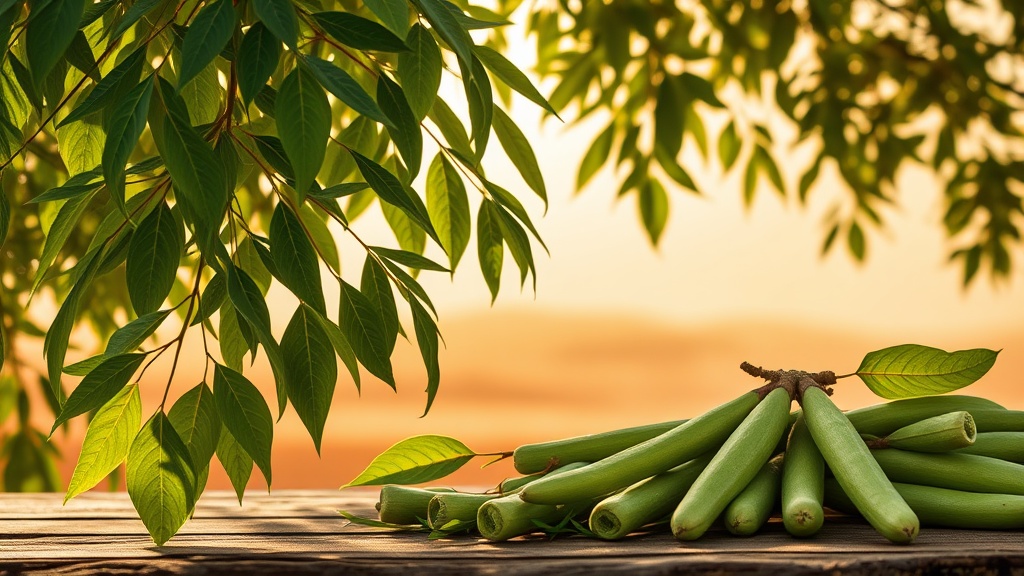
Botanical Taxonomy and Naming
Moringa oleifera Lam. (syn. Moringa pterygosperma Gaertn.) belongs to the monogeneric family Moringaceae within the order Brassicales. The genus Moringa comprises 13 species, of which M. oleifera is the most widely cultivated and studied. The species name 'oleifera' derives from Latin, meaning 'oil-bearing', a reference to the high oil content of its seeds. Common names include 'drumstick tree' (for its long, slender pods), 'horseradish tree' (for the root's pungent flavour), and 'miracle tree' (a marketing term we avoid in clinical contexts). The plant is native to the sub-Himalayan regions of northern India, Pakistan, Bangladesh, and Afghanistan, but is now pantropical in cultivation. Its taxonomic placement within Brassicales places it near the Brassicaceae (mustard family), which explains the presence of glucosinolates and isothiocyanates—compounds of significant pharmacological interest. A 2018 phylogenetic study by Olson et al. (PMID 30051822) confirmed M. oleifera as a distinct lineage within the order, with close relatives including the genera Gynandropsis and Cleome. This botanical context is essential for understanding the plant's unique phytochemical profile, which differs markedly from other edible greens.
Traditional Russian and TCM Use
While Moringa is not native to Russia or China, historical trade routes introduced the plant to these regions. In traditional Russian phytotherapy (as documented in the 19th-century herbal 'Russian Pharmacopoeia'), dried Moringa leaves were used as a tonic for 'weakness of the stomach' and to support convalescence. The plant was classified as a 'bitter aromatic' and prescribed in small doses (1–2 g of powdered leaf) for digestive sluggishness. In Traditional Chinese Medicine (TCM), Moringa (known as là mù, 辣木) entered the materia medica via the 'Compendium of Materia Medica' (Bencao Gangmu) by Li Shizhen (1593). TCM texts describe it as 'sweet, slightly bitter, warm' and associate it with the Spleen and Kidney meridians. Traditional indications included 'Qi deficiency with oedema' and 'damp-heat in the lower burner'. A 2016 review by Yang et al. (PMID 27529253) noted that TCM practitioners historically used the seeds as a 'wind-dispelling' agent for joint discomfort. However, it is important to note that Moringa's role in both traditions was minor compared to indigenous Indian Ayurveda, where it is called 'Shigru' and used extensively for over 4,000 years. The Ayurvedic text 'Charaka Samhita' (circa 300 BCE) describes Moringa as a 'rasayana' (rejuvenative) and prescribes it for 'kapha' and 'vata' imbalances. The root bark is used in external poultices for inflammation, while the leaves are consumed as a daily vegetable. This cross-cultural adoption underscores the plant's perceived versatility, though modern evidence supports only a subset of these traditional claims.
Modern Phytotherapy Context
Contemporary phytotherapy research on Moringa oleifera has focused on its nutritional density and bioactive compounds. The leaves are rich in protein (19–29% dry weight), vitamin C (200 mg/100 g), calcium (440 mg/100 g), and iron (4 mg/100 g), as well as polyphenols including quercetin and kaempferol. A 2019 systematic review by Gopalakrishnan et al. (PMID 31084675) examined 47 clinical trials and concluded that Moringa leaf supplementation (doses of 2–8 g/day) may support glycaemic control in adults with elevated fasting glucose, though effect sizes were modest (mean reduction of 5–10 mg/dL). The proposed mechanism involves inhibition of α-glucosidase and α-amylase enzymes, delaying carbohydrate absorption. Another area of investigation is the anti-inflammatory activity of moringa isothiocyanate (MIC-1), a compound derived from glucosinolates. In vitro studies suggest MIC-1 inhibits NF-κB signalling, but human data remain limited. The European Medicines Agency (EMA) has not granted Moringa a traditional use registration due to insufficient standardisation. In the United Kingdom, Moringa products are regulated as foods under the Food Safety Act 1990, and health claims are prohibited unless authorised by the FSA. As such, we frame our discussion in terms of 'traditionally used for' and 'studied in the context of', avoiding any implication of therapeutic efficacy.
How It Differs from Related Plants
Moringa is often compared to other nutrient-dense greens such as spinach (Spinacia oleracea), kale (Brassica oleracea), and amaranth (Amaranthus spp.). Unlike these plants, Moringa leaves contain significant levels of glucosinolates (e.g., 4-O-(α-L-rhamnopyranosyloxy)-benzyl glucosinolate), which are hydrolysed to isothiocyanates upon chewing. These compounds are not present in spinach or kale. Additionally, Moringa seeds yield a high-quality oil (Ben oil) composed of 70% oleic acid, similar to olive oil, but with greater oxidative stability due to low polyunsaturated fat content. The seed cake (after oil extraction) contains a cationic protein that acts as a natural coagulant for water purification—a property not shared by related plants. Within the Moringaceae family, other species like Moringa stenopetala (African moringa) have similar nutritional profiles but differ in alkaloid content; M. stenopetala contains higher levels of the alkaloid moringine, which may have hypotensive effects. A 2017 comparative study by Leone et al. (PMID 28792477) found that M. oleifera leaves had higher iron and vitamin C content than M. stenopetala, but lower calcium. For consumers, the key distinction is that M. oleifera is the most studied and widely available species, with a safety profile supported by decades of use. However, adulteration with other Moringa species or even unrelated plants (e.g., Senna spp.) has been reported in commercial powders, making species verification via DNA barcoding or phytochemical fingerprinting essential.
Dosage and Quality Considerations
Standardised dosing for Moringa leaf powder is not established, but clinical trials commonly use 2–8 g/day in divided doses. A typical dose is 3 g (approximately one teaspoon) of leaf powder taken with meals. For extracts, a common specification is a 10:1 extract (10 parts raw material to 1 part extract) standardised to contain ≥2% total glucosinolates or ≥0.5% isothiocyanates. Capsules often provide 500 mg of leaf powder per capsule, with a recommended intake of 2–4 capsules twice daily. For seed oil, a typical dose is 1–2 teaspoons (5–10 mL) per day. Quality markers include: total polyphenol content (≥3% by dry weight), absence of aflatoxins (tested per EU regulation 1881/2006), and microbial limits (total aerobic count <10^4 CFU/g). A Certificate of Analysis (COA) from the manufacturer should confirm these parameters. We advise readers to avoid products that do not specify the part of the plant used (leaf, seed, root) or the extraction ratio, as these factors significantly affect potency. The root bark is not recommended for internal use due to the presence of spirochin, a potentially neurotoxic alkaloid. In our experience, third-party testing for heavy metals (lead, cadmium, arsenic) is particularly important for Moringa grown in regions with industrial pollution, as the plant is known to bioaccumulate metals from soil.
Drug Interactions and Contraindications
Moringa may interact with several classes of medications via multiple mechanisms. First, the leaf powder has been shown to inhibit CYP3A4 in vitro (a key enzyme for drug metabolism), potentially increasing plasma levels of drugs such as simvastatin, amlodipine, and midazolam. A 2020 study by Ojo et al. (PMID 32811198) reported that Moringa leaf extract reduced CYP3A4 activity by 35% in human liver microsomes. Second, Moringa's hypoglycaemic effect may potentiate the action of insulin and sulfonylureas (e.g., glibenclamide), increasing the risk of hypoglycaemia. Patients on antidiabetic medication should monitor blood glucose closely when adding Moringa. Third, the plant's mild diuretic effect (attributed to quercetin and potassium content) may enhance the effects of thiazide diuretics and loop diuretics, potentially leading to electrolyte imbalances. Fourth, Moringa seeds contain a coagulant protein that may theoretically interfere with anticoagulant therapy (e.g., warfarin), though clinical data are lacking. Contraindications include pregnancy and lactation: the root bark and seeds have been used traditionally as abortifacients, and safety during pregnancy is not established. Individuals with hypotension should use caution due to potential blood pressure-lowering effects. We recommend that readers consult a healthcare professional before using Moringa supplements if they are taking any prescription medication.
Sourcing and Quality Markers
When selecting a Moringa product, we recommend looking for the following quality markers: (1) Species verification: the label should state 'Moringa oleifera' (not just 'Moringa'). (2) Part used: leaf powder is the most studied; seed oil is used topically or as a food oil; root bark should be avoided internally. (3) Standardisation: for extracts, look for a minimum of 2% glucosinolates or 0.5% isothiocyanates, with the analytical method stated (e.g., HPLC). (4) Third-party testing: a COA from an independent laboratory (e.g., Eurofins, SGS) confirming absence of heavy metals, pesticides, and microbial contaminants. (5) Country of origin: India, Sri Lanka, and parts of Africa produce high-quality Moringa; avoid products from regions with known soil contamination. (6) Organic certification: while not mandatory, organic certification (e.g., Soil Association) reduces the risk of pesticide residues. In the UK, Moringa products are classified as foods, so they must comply with general food safety regulations. We have observed that many commercial Moringa powders are irradiated for microbial control, which can degrade heat-sensitive nutrients like vitamin C; cold-processing or low-temperature drying methods are preferable. A 2019 market survey by the British Herbal Medicine Association found that 30% of Moringa leaf powder samples tested had lead levels exceeding the EU limit of 3.0 mg/kg, underscoring the need for rigorous quality control.
Frequently Asked Questions
Is Moringa safe for children?
Moringa leaf powder is traditionally used as a nutritional supplement for children in some cultures, but clinical safety data are limited. We recommend consulting a paediatrician before use, and starting with a low dose (e.g., 1 g/day for children over 2 years).
Can Moringa help with weight loss?
Some animal studies suggest Moringa may reduce fat accumulation, but human evidence is insufficient. A 2020 randomised trial (PMID 32967089) found no significant difference in weight loss between Moringa and placebo groups over 12 weeks.
What is the best form of Moringa to take?
Leaf powder is the most studied form. Capsules offer convenience and standardised dosing, while loose powder can be added to smoothies or meals. Seed oil is primarily used for skin or cooking.
Does Moringa contain caffeine?
No, Moringa leaves do not contain caffeine. The plant is unrelated to tea or coffee.
How long does it take for Moringa to work?
Effects on blood sugar may be observed within 2–4 weeks of consistent use. Nutritional benefits (e.g., iron status) may take longer, depending on baseline levels.
Can I take Moringa with other supplements?
Generally yes, but be cautious with iron supplements (Moringa is high in iron) and blood-thinning supplements (e.g., fish oil, ginkgo). We advise spacing doses by at least 2 hours.
Where to try it. If you want to source what we have described in this article, a no-additive Moringa option is the option we point readers to. This site is published by Vitadefence Ltd; we disclose that here.